Productlane
Support Inbox
Email, live chat, and Slack in one inbox.
AI agent
Resolve tickets automatically with AI.
Help Center
Self-updating knowledge base for customers.
Support Portal
A dedicated portal for customer support.
Feedback Portal
Collect feedback and share your roadmap.
Changelog
Auto-generate and broadcast product updates.
CustomersPricing
Changelog
See our latest changes and improvements.
Docs
Learn how to get the most out of Productlane.
API Docs
Extend your support process with our API.
Blog
Insights on support, product, and engineering.
Contact
Login
Productlane

Designed in Munich

Product

  • Pricing
  • Changelog
  • Our Roadmap
  • Your requests
  • Documentation
  • Zendesk importer

Features

  • Help Center
  • AI Agent
  • Omnichannel support
  • Feedback Portal
  • Changelog
  • Support portal

Resources

  • API
  • DPA
  • Imprint
  • Status
  • Terms
  • Privacy

Company

  • Blog
  • Contact
  • LinkedIn
  • X Twitter
  • Customers
Blog/FAQ Page Examples and a Template That Deflects Support Tickets

FAQ Page Examples and a Template That Deflects Support Tickets

Khadim Fall
Khadim Fall · Jul 16, 2026
A grid of FAQ entries with one row surfaced
TL;DR

The best FAQ page examples share four patterns: a searchable accordion, category-grouped questions, inline FAQs placed in context, and an FAQ that feeds a full help center. A strong FAQ page answers the question in the first sentence, groups the rest by topic, and ships FAQPage schema so answers surface in search. Copy the template, fill the slots with your own top tickets, and ship.

This guide gives you concrete FAQ page examples worth copying, the anatomy behind each, a reusable template with eight labelled question slots, the moment to graduate an FAQ into a help center, and a simple habit for keeping that content fresh as the product ships.

A good FAQ page is the cheapest support you will ever run. It answers the questions customers ask most, before they open a ticket, in the seconds they spend deciding whether to buy or whether to email you. The best FAQ page examples all do the same handful of things well, and once you see the pattern you can copy it onto your own site in an afternoon.

This article collects FAQ page examples by pattern rather than by brand, because patterns travel. You will get the anatomy of a page that converts, a reusable template you can paste into your CMS, the rules for writing answers that rank, and the signal that tells you it is time to graduate from a single FAQ page to a structured help center.

What makes an FAQ page work

An FAQ page works when it removes a decision from the reader. They arrived with a specific worry (does this integrate with my stack, can I cancel, is my data safe) and they want the answer in one glance. The pages that do this well share a few traits:

  • Answer-first writing. The first sentence of every answer is the answer. Context, caveats, and links come after. A reader scanning ten questions can read just the opening line of each and leave satisfied.
  • Real questions in real words. The question text matches how customers actually phrase it, including the words they type into search. “How do I cancel?” beats “Subscription lifecycle management.”
  • Scannable structure. An accordion or a grouped list lets the eye jump to the relevant question. A wall of stacked paragraphs makes the reader work.
  • A clear exit. When the FAQ does not cover it, one obvious link or button points to the help center, the contact form, or the in-app widget.

FAQ page examples worth copying

These are the four FAQ page examples that show up across the SaaS sites with the lowest support volume. Each solves a different problem. Pick the pattern that matches where your questions live.

1. The searchable accordion

A single page with a search box at the top and questions collapsed into an accordion below. The reader types a keyword, the list filters to matching questions, and tapping one expands the answer in place. This pattern fits a product with 15 to 40 common questions: enough to need search, few enough to fit on one page. Stripe's support landing and most pricing-page FAQs use this shape. The win is speed, the reader never leaves the page, and the answer appears under the question they tapped.

2. Category-grouped questions

Questions split into labelled sections (Billing, Security, Getting started, Integrations) with a sticky table of contents down the side. The reader picks the category that matches their worry, then scans the four or five questions inside it. This pattern fits a product where questions cluster by audience or lifecycle stage: a buyer cares about pricing and security, an existing user cares about workflows and limits. Notion's and Linear's help surfaces lean on grouping. The structure also doubles as a sitemap that search engines read cleanly.

3. Inline contextual FAQs

Three to five questions placed directly where the doubt occurs: a short FAQ under the pricing table answering “can I change my plan,” a two-question block on the checkout step answering “is my card stored.” These are not a central page at all, they are FAQ snippets distributed across the site at the exact moment the reader hesitates. This pattern converts the best because it removes the objection without making the reader navigate away. Pair it with a full FAQ page for the long tail.

4. The FAQ that feeds a help center

The FAQ page lists the top 20 questions, and each answer ends with a link to a fuller article in the help center. The FAQ handles the quick hit, the help center handles the customer who wants the full walkthrough. This is the pattern that scales, because the FAQ stays short and curated while the depth lives in a searchable knowledge base behind it. It is also the natural setup for an AI agent, which reads both the FAQ and the articles to answer in the customer's own words.

The anatomy of a strong FAQ page

Whichever pattern you pick, the parts of the page line up the same way from top to bottom. Build it in this order:

A heading that names the page

“Frequently asked questions” or a topic-scoped version (“Billing FAQ”). Plain wins here, the heading is a label, not a slogan.

Search or a table of contents

Once you pass roughly a dozen questions, the reader needs a way in. A search box for the accordion pattern, a jump-to list for the grouped pattern. Below a dozen questions, skip it, a short list is faster to scan than to search.

Questions ordered by frequency

The most-asked question goes first. Pull the order straight from your ticket data: the topics that generate the most inbound volume earn the top slots. Vanity ordering (alphabetical, or whatever you thought of first) buries the answers people actually want.

Answers that lead with the answer

One to three sentences. The first sentence resolves the question, the rest adds the caveat or the link. Keep each answer to one question, if an answer sprawls into three subtopics, it is three questions wearing a trench coat.

An exit for the unanswered

A single clear next step at the bottom: open the in-app widget, browse the full help center, or contact support. One exit, not five. The reader who got this far without an answer needs direction, not a menu.


A reusable FAQ template you can copy

Most SaaS FAQ pages answer the same eight families of question. Use the slots below as a starting skeleton, swap the example questions for your own wording, and order them by how often each topic shows up in your inbox. Each slot lists an example question you can adapt.

  1. Getting started. “How do I set up [product] for my team?” Lead with the single fastest path to first value, then link the full setup guide.
  2. Pricing and plans. “How much does [product] cost, and can I change plans later?” State the entry price and the upgrade rule in the first sentence.
  3. Billing and cancellation. “How do I cancel or get a refund?” Be direct, this is the question buyers check before they commit.
  4. Security and data. “Where is my data stored, and is it encrypted?” Name the region, the standard, and link the security or DPA page.
  5. Integrations. “Does [product] integrate with [tool]?” List the named integrations explicitly, since people search by tool name.
  6. Limits and usage. “How many seats, projects, or messages are included?” Give the number, then the overage rule.
  7. Account and access. “How do I add teammates or reset my password?” Short, step-led answers; these are the highest-volume support tickets.
  8. Support and next steps. “How do I reach a human if this does not cover it?” Point to the widget or help center and set a response-time expectation.

FAQ vs help center: when to graduate

An FAQ page and a help center solve overlapping problems at different scales. An FAQ is a curated shortlist of the most common questions, one page, answered in a sentence or two. A help center is a searchable library of articles, each one a full walkthrough with screenshots and steps.

Start with an FAQ. It is faster to build and it covers the long tail of pre-sale questions that never warrant a full article. Graduate to a help center when any of these become true:

  • The page passes 30 to 40 questions and the accordion stops being scannable.
  • Answers keep growing past three sentences because the real answer is a multi-step walkthrough.
  • You want an AI agent to deflect tickets, which needs structured articles to ground its answers, not a flat list.
  • Different audiences (admins, end users, developers) need different depth on the same topic.

The clean migration is to keep the FAQ as the curated front door and let each answer link into a fuller article. For the structured-knowledge side of this, our guide to building an AI help center covers the article-grounding side in depth, and the internal knowledge base guide covers the version your own team reads.


SEO for FAQ pages

FAQ pages earn organic traffic because they match how people search: full questions, typed in natural language. Three things make the difference between an FAQ that ranks and one that sits unread.

Write the answer first

Search engines and AI answer engines lift the first sentence of an answer as the response. Front-load it. “Yes, you can cancel any time from Settings” gets quoted, “We understand that circumstances change, and so…” does not.

Add FAQPage schema

Mark up the page with FAQPage structured data (JSON-LD), pairing each question and its answer. This is what lets the questions appear as expandable results and feeds answer engines a clean question-answer map. This very article ships that schema; view source on the FAQ section below to see the exact shape.

Match the searched phrasing

Use the question wording people actually search. Pull phrasings from your support inbox and from search query data, then make the question heading match. The closer the heading is to the typed query, the more likely the page is the one that surfaces.


Keeping FAQ and help center content fresh

The reason most FAQ pages decay is the same reason help centers decay: the product ships, the docs do not. The fix is a writing habit and a review cadence. Tie each release to a content check, pull the new questions straight from your inbox, and retire answers that no longer match the product. Whatever tool holds the content, the discipline is the same: the page is only as current as your last edit.

This is also where tooling can carry some of the load. Productlane, for example, watches your shipped Linear issues and proposes help center article drafts when a customer-facing surface changes, so the answers stay close to the product without a manual writing pass each time.


Frequently asked questions

An FAQ page should include the questions customers ask most, ordered by frequency, each answered in one to three sentences with the answer first. The strongest FAQ page examples also add search or category grouping once they pass a dozen questions, FAQPage schema for search, and a single clear exit to the help center or contact form for anything the page does not cover.

Aim for the 10 to 25 questions that cover the bulk of your inbound volume. Below ten, a short stacked list is enough. Past 30 to 40, the accordion stops being scannable and the content belongs in a structured help center with the FAQ kept as a curated front door.

An FAQ page is a curated shortlist of common questions answered in a sentence or two on a single page. A help center is a searchable library of full articles, each a step-by-step walkthrough. Start with an FAQ, then graduate to a help center when answers grow past three sentences or you want an AI agent to deflect tickets from structured content.

Yes. FAQ pages match natural-language search queries, and FAQPage structured data lets the questions surface as expandable results and feeds answer engines a clean question-answer map. Lead each answer with the answer itself, since search and AI engines lift the first sentence as the response.

FAQ schema is FAQPage JSON-LD structured data that pairs each question with its answer so search engines can read them as a question-answer set. Add it to any page built as a genuine list of questions and answers. It is what lets your FAQ appear as expandable rich results and helps AI answer engines quote you accurately.

Lead with the answer in the first sentence, keep each answer to one question, and use the wording customers actually search. Add the caveat or the link after the answer, not before it. If an answer covers three subtopics, split it into three questions.

Productlane drafts help center articles from shipped Linear issues: when an issue is marked Done and the customer-facing surface changed, it proposes an article for one-click approval. An AI agent then answers from that content, billed per resolved conversation (roughly 79 cents each), in 47 languages, embedded in your app.


Ship an FAQ page this week

Pick the pattern that matches where your questions live, copy the eight-slot template, order the slots by your real ticket volume, and lead every answer with the answer. Add FAQPage schema and a single exit to your help center. That is a page customers can self-serve from on the day you publish it.

When the FAQ outgrows one page, Productlane can carry the content forward: a help center that drafts fresh articles whenever a Linear issue ships a customer-facing change, an AI agent that answers from that content (priced per resolved conversation, around 79 cents each), and an in-app widget localized across 47 languages. The inbox, feedback portal, roadmap, and changelog live in the same tool.

You can try Productlane for free, check pricing (plans open at $29 per seat each month on the annual plan), or read our guide to building an AI help center for the depth behind the FAQ.

Customer support for Linear

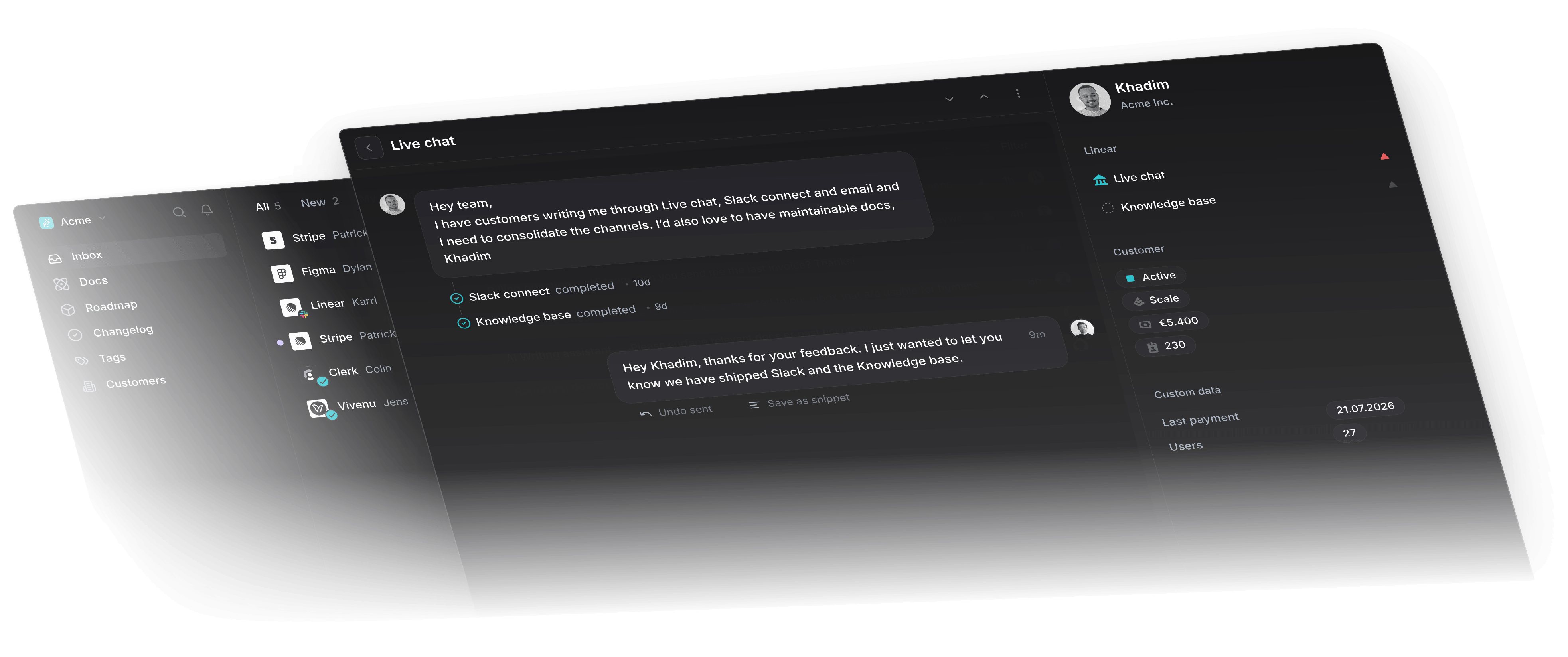
Productlane inbox with live chat conversation, thread list, and customer sidebar